Showing posts with label Hinduism. Show all posts

Friday, September 16, 2022

Pchum Ben: A Feast For The Souls

On the 1st day of the 10th month of the Khmer calendar (Sept 15 on the Gregorian calendar this year), Lord Yama, the God of Death, opens the gates of hell that will remain open for the next 15 days. It’s the start of Pchum Ben, better known as the Festival of the Dead to foreigners. When the Lord of Death opens the gates, he allows trapped souls to find their living relatives to receive merit and karma transfer. Trapped souls are suffering souls. Khmers believe in the Hindu concept of reincarnation. We believe that souls are not reborn right away. Some souls are trapped in hell (the spirit realm) and some are still wandering in the human realm. If a deceased person did not receive a proper cremation, his or her soul might linger on earth. We also believe that if a person dies a violent death, a tragic death, or an unjust death, his/her soul becomes a restless soul, and a restless soul cannot move on. Also, there are those who accumulated bad karma (action has consequences) in their previous lives, which resulted in their souls being trapped in hell. Merit and karma transferring rituals are performed in order to release suffering souls.

Merit and karma transferring is a process that is centered on the belief of taking refuge in the dhamma (Buddha’s teaching) and the sangha (ordained monks and nuns). Merit is viewed as a means of transferring karmic power from one relative to another. Merit is morally generated. Therefore, it has the power to morally regenerate in turn. Merit is morally generated because it comes from selfless acts. Charities or aids made by laymen to monks, nuns, and the general public are viewed as aids with no strings attached, meaning aids that are not offered to generate merit for oneself. They are offered for the benefit of others who need the ensuing merit. The ability to give and receive in inherent goodness allows relatives the means to provide care and comfort for their departed, and to help lessen their suffering, so these souls can garner karmic support and finally move on.

Pchum Ben was born out of Khmer animistic beliefs and was co-opted by Hinduism after it reached Cambodia around 500 BC. It went on to be co-opted by Theravada Buddhism after the decline of Hinduism in Cambodia in the 16th century. Until the late 9th century, Pchum Ben was celebrated on an individual or family level. According to an inscription, King Yasovarman I (r. 889-910) was the first ruler to organize a nationwide Pchum Ben service dedicated to the country’s dead soldiers. And it has since become a national service.

The first 14 days of the festival are called Kan Ben. Kan means to hold. Ben is an offering, derived from the Sanskrit pinda, a ball of rice to be offered to the souls of the dead. During these 14 days, Khmers offer food and gifts to monks, nuns, and various elderly people at monasteries. The last day of the festival is called Pchum Ben. Pchum means gathering. On this last and most important day of the festival, at every monastery, massive collections of bens are gathered around the five mounds constructed from rice or sand, representing Mount Meru, home of the Gods. Those bens are then dedicated to the souls of the dead who have no living relatives or whose living relatives, for whatever reason, couldn’t participate in the 15-day event.

Considering the bloodshed in recent Cambodian history, the festival has become the single most important event in Khmer lives. With the killings during the Khmer Rouge era, victims or killers may have had their souls condemned to wander; their souls are doomed to never reincarnate unless the living provide relief in proper rituals, and Pchum Ben is one such ritual.

Source: Caring for the Dead Ritually in Cambodia (2012) by John Clifford Holt


Saturday, April 13, 2019

Tug-of-War and the Khmer New Year

This year, Khmer New Year falls on April 14, 15 and 16. All over Cambodia, people play various traditional games in the days leading up to and on New Year days. A few are ritual games to be played only on those New Year days. Teanh prot (pulling the rope) is one such game. It is a game most people would understand as tug-of-war.
Teanh prot is to be played on the last day of New Year in the village square or on temple ground. According to old Khmer tales, the origin of this game can be traced back to samudra manthana, the Hindu myth of the Churning of the Ocean of Milk. The myth tells of a time long long ago when gods and demons came together to churn the Cosmic Ocean in order to obtain amrita, the elixir of immortality. The Churning was an elaborate process. Mount Mandara was used as a churning rod and the serpent Vasuki (Lord Shiva’s naga) offered himself as a churning rope. Out of the Ocean, many treasures arose, including the apsaras (celestial dancers), one of whom would later become the progenitor of the Khmer race. Khmers view the Churning as chaos. We view ourselves as creation born of chaos. We also view New Year days as one chaotic period, betwixt the old and the new year.
The game of teanh prot requires a 30-foot rope as thick as a small wrist. The rope is usually made of water buffalo hide or braided vines and palm leaves. A drums is needed to signal the start and to accompany the game. The players are divided into two teams, males vs. females, of at least 10 people per team, though the female team usually has at least two more people than the male team. The rope is marked at the center by a color knot. When one team is pulled over where the color knot passes the marked line, the other team wins the game. The winners bump their buttocks against the losers’ bodies. In the past, a brahmin would cut off the rope at the end of the game, which symbolized the end of the old year and the start of the new. Also, the last day of New Year is known as pdach prot “cutting off the rope.”
If you ever find yourself in Cambodia around New Year, join in a game or two.
Happy New Year!

Monday, January 21, 2019

Eclipses

There was a total lunar eclipse last night. If you were outside anywhere in the
Northern Hemisphere, you could have seen it. In Khmer language, lunar eclipse
is called rahu chab chan, meaning Rahu catches/swallows the Moon. So who
is Rahu? Well, Rahu is a demon.  And his story and the origin of eclipse dated
all the way back to samudra manthana, the Churning of the Ocean of Milk, in a
time when demons were on the ascension in the universe.
It all started with the suggestion of Lord Vishnu, that gods and demons come
together to churn the Cosmic Ocean in order to obtain amrita, the elixir of
immortality. The churning was an elaborate process. Mount Mandara was used
as a churning rod and the serpent Vasuki (Lord Shiva’s naga) offered himself
as a churning rope. Herbs of every kind were tossed into the Ocean. And out
of the Ocean, many treasures arose, including the Goddess Lakshmi,
shankha (Vishnu’s conch), the apsaras (celestial dancers), and at the end, the
celestial physician Dhanvantari emerged holding the pot containing the elixir.
The demons snagged the pot and battle broke out between the two sides.
Vishnu, in the form of the enchantress Mohini, his only female avatar, beguiled
the demons into handing over the pot to her. She then distributed the elixir to
the gods. One demon, Svarbhanu, who kept his sight on the pot the entire time,
disguised himself as a god in order to take a sip of the elixir. Surya (the Sun)
and Chandra (the Moon) noticed and informed Vishnu, who proceeded to
behead Svarbhanu instantly. But Svarbhanu already took a sip of the elixir
and as a result, his head became immortal and known as Rahu. But since
he was beheaded before the elixir could pass down his throat, his body died
and became known as Ketu.
Unsurprisingly, Rahu holds a grudge against the Sun and the Moon. He chases
them to exact his revenge and once in awhile he catches up to either one. And
since Rahu is just a head, when he catches up to either the Sun or the Moon,
he tries to swallow either one. Sometimes, Rahu manages to swallow the Sun
or the Moon entirely. But since he has no body, eventually the Sun or the
Moon comes back out again.
This, dear readers, is how eclipses happen.


Sunday, December 31, 2017

Num Kom and Fertility

Num kom is a Khmer cake wrapped in banana leaves in a pyramid shape. It is made with glutinous rice flour and has coconut, palm sugar, and black sesame seeds filling. Khmers usually serve num kom as a dessert at big gatherings. But num kom also has a religious connotation; it is a representation of the yoni (vulva, womb), a personification of the divine feminine creative power. If you know your Hinduism, you’d know that the yoni is the counterpart to the linga, which is the mark of Lord Shiva. So of course, num kom has its own counterpart, num ansom which represents the linga. At engagement and wedding ceremonies, num kom and num ansom are always presented together to symbolize the union of the linga and the yoni, the representation of the eternal process of creation and regeneration, the union of male and female principles. In Khmer that union is called mea ba. Num ansom and its meaning will be covered in a future post.
Num Kom
16 oz. grated coconut (I used frozen coconut, thawed)
8 oz. palm sugar
1 oz. black sesame seeds, roasted
A generous pinch of salt
12.3 oz. glutinous rice flour (about 3 cups)
1 ½ cups warm water
Banana leaves for wrapping

Prepare the filling: heat a pan over low heat. Add palm sugar and cook until the sugar is dissolved. Add the grated coconut and salt. Simmer until the coconut becomes sticky and has absorbed all the sugar. Remove from heat, sprinkle with sesame seeds and allow it to cool. Make small balls of the mixture, about 1 tbsp. size. You’ll get about 24 to 27 balls.

Make the dough: place the rice flour in a mixing bowl and add warm water and mix until it resembles smooth workable dough that is not too wet and can hold its shape. If it crumbles, it’s too dry, just add a bit more water. If it is too soft, add a few pinches of flour. Cover the dough with plastic wrap to prevent it from drying out.

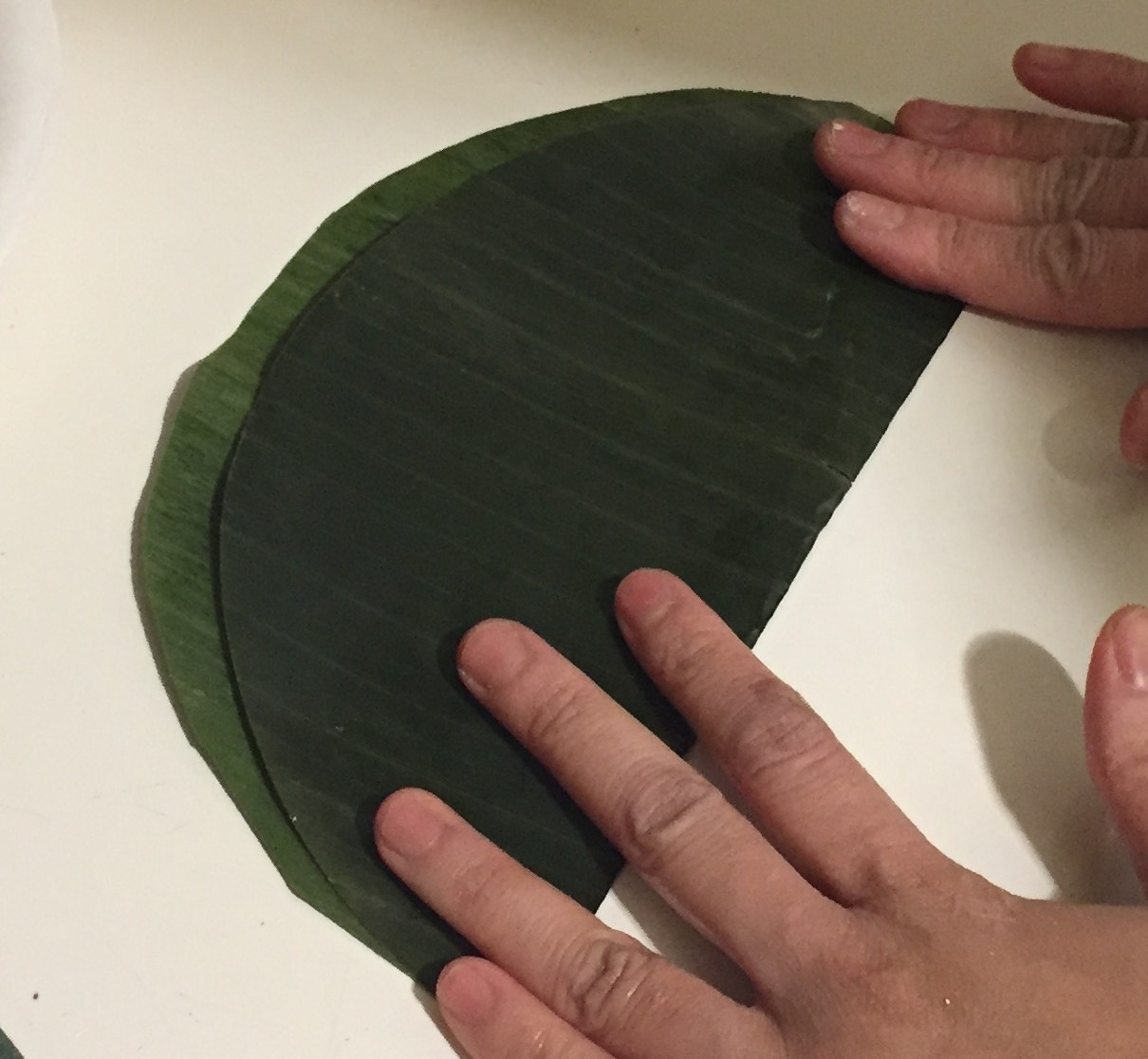
Prepare the banana leaves: cut the banana leaves into round shapes of 9 inch diameter. Grease the leaves with flavorless oil. And bring a big pot of water to a boil.

To assemble the cakes: take a piece of dough, about 1 tbsp. and roll it into a ball. Place each ball of dough on the palm of your hand and lightly flatten the ball. Place the filling in the center and bring the edges of the dough up over the filling and seal the ball by pinching the sides together. Roll it into a ball. Repeat with the rest of the dough.

To wrap the cakes: follow these pictures below 


Steam the cakes for 20 minutes.